Attendance management systems have become increasingly common, thanks to the growth of remote and hybrid work environments. However, remote and hybrid setups also require multiple tools to empower their employees to undertake their work effectively, while staying engaged with their organization.
This is where an attendance software comes into play, as these systems provide accurate attendance capture and tamper-proof storage of the captured data. Most modern attendance systems provide some form of biometric attendance marking techniques, with fingerprint scanners being the most popular, followed by face recognition.
However, many HRs still have doubts about the accuracy of face recognition technology. Hence, we are sharing how face recognition works in an attendance system, along with its benefits and the must-have features for this software.
Attendance management systems have become increasingly common, thanks to the growth of remote and hybrid work
Biometric Face Recognition is a technology that identifies an individual’s
identity by analyzing their unique facial features from an image or video. It utilizes
Artificial Intelligence and Machine Learning to create either a 2D or 3D map of facial
landmarks, and converts it into a digital template, which can be used in various
applications, like unlocking secure doors, capturing attendance, and more.
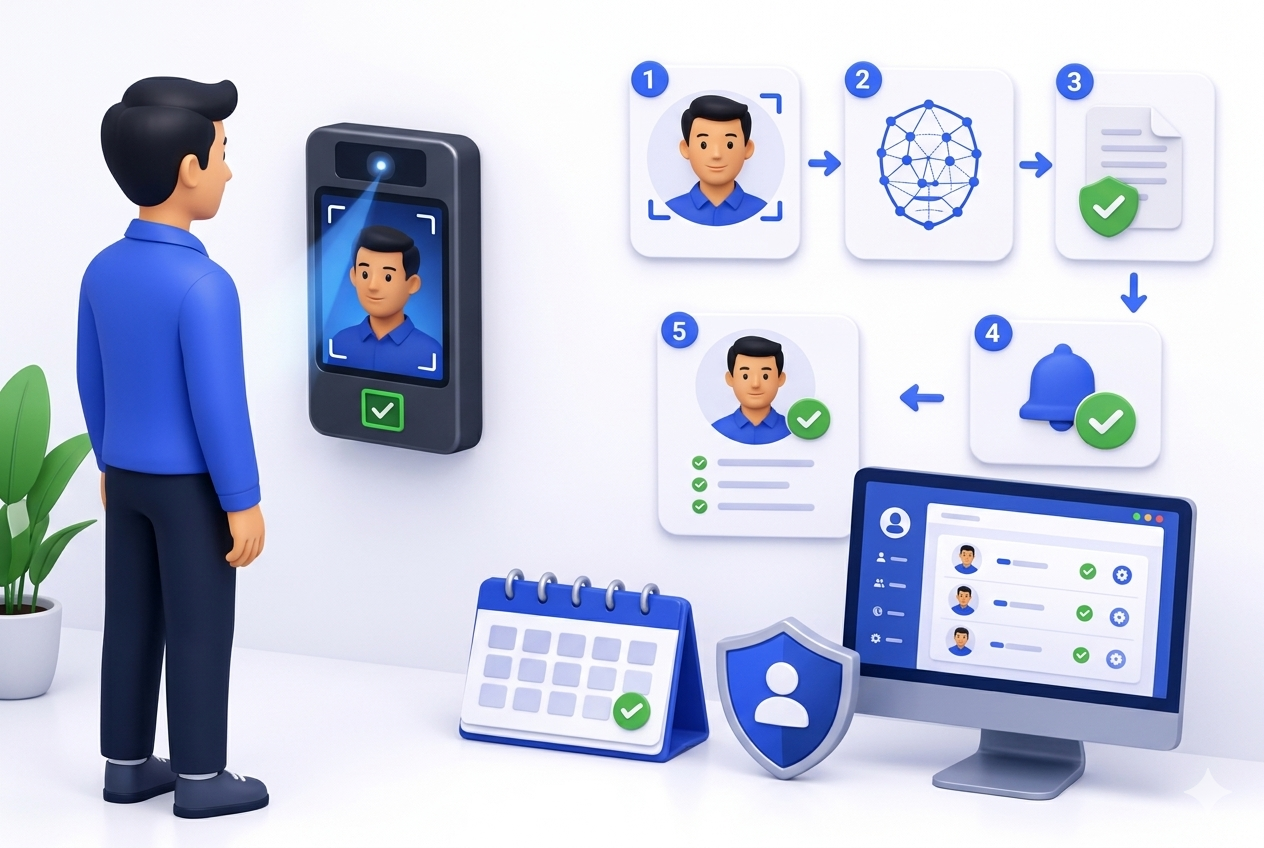
To make it work, an image of the individual’s face is captured using a normal camera.
This image is fed to an algorithm that measures and marks unique features of the face,
such as the distance between eyebrows, the shape of the nose, chin dimples, etc.,
generates a numerical code or a digital facial template, and stores it in a secure
database.
Whenever the individual scans their face, the system captures their face, and the
algorithm generates the same facial template, which is verified against the existing
template. If they match, the individual passes verification.
An attendance system with face recognition uses the face recognition
algorithm to mark an employee’s attendance. To use this system, employers ask their
recruits to submit their images to their HR department to generate their facial template
for the algorithm.
Once the biometric data is entered into the system, employees can use the necessary
hardware, like a physical camera at their company’s main entrance or their smartphone
camera (in case of remote employees), to capture their image while clocking in and out.
Having this option provides numerous benefits for the employees and the employer as it
automates the entire attendance capture process, while making it accurate and
tamper-proof. It also offers an engaging attendance capture experience for the
employees, while also saving them from having to punch in and out manually.
Having a face recognition system for employees helps improve the efficiency and
effectiveness of attendance management within the organization. It not only automates
the complete process of attendance capture but also makes it interactive, which further
helps in its adoption.
Deploying face recognition for managing your attendance also helps with the following
benefits:
1. Improved Security
Face recognition provides enhanced security to employee attendance data, as making
fraudulent changes to the system is extremely hard. These systems convert the facial
template into a numerical value and store it in the database, which is further encrypted
to avoid tampering. Having such foolproof options to save employee attendance ensures
complete accuracy.
2. Controlled Access
Similarly, face recognition attendance systems also provide controlled access to the
employees and HR based on their user role within the software. With controlled access,
employees can view only their attendance information, while supervisors and managers can
view their entire team’s attendance data. Similarly, the HR team will have administrator
privileges, enabling them to edit all values as per their requirements.
3. Time Theft Avoidance
Since it is virtually impossible to tamper with the face recognition system, you can
avoid time theft using an attendance software equipped with it. With the aforementioned
security features, you can avoid any instances of attendance fraud as the system ensures
foolproof attendance. Modern systems even provide ‘liveliness detection’ using AI,
ensuring that the employee is physically present in front of the camera instead of their
image or video, to avoid any kind of fraud.
4. Employee Accountability
Another major benefit of employee attendance management via face recognition is that it
can be tracked throughout the organization. It helps organizations understand whether
anyone is leaving the office premises during their shift. Similarly, if an employee logs
in and tries to while away their time by not being at their desk, the system can capture
their face from CCTVs placed throughout the company, letting their managers know of
their time theft.
5. Contactless Attendance
Contactless attendance is another benefit of having a face recognition system. Employees
can mark their attendance simply by Howing their faces to the camera, making it easier
for them to mark their daily attendance. It is both convenient and hygienic for
health-conscious workplaces like hospitals, as no contact is required with the hardware.
6. Real-time Data Access
Similarly, you can also access real-time attendance data with this kind of attendance
system, making it extremely convenient to gather quick insights into currently active
employees, absent staff members, etc. With integration with HR MIS Report,
decision-making becomes easier, further making the organization agile. For example,
real-time data also provides accurate information about employee absenteeism patterns,
aiding you in making strategic decisions.
7. User-friendly Experience
Face recognition-based attendance systems require almost no training for the employees,
as they are quite intuitive to use. Additionally, since the system does not require any
inputs from the employees, it can be used by blue-collar workers who may not be
well-versed with technology, further enhancing its adoptability in organizations. Such a
user-friendly experience leads to smoother interactions and quicker implementation,
making it a win-win for companies.
Also Read: How to Choose the Right Attendance Management System?
Face recognition is the core of attendance systems that enable companies to provide a
quick, contactless, and engaging attendance capture experience for employees. It also
helps employers capture accurate and foolproof data while enabling real-time data
access.
Now that we have understood the benefits of a face recognition-based attendance
management system, let us check out its major aspects:
➔ Face Enrolment
The face recognition process starts by enrolling the employee’s face into the system.
When an employee joins the organization, their photo is uploaded into the system with
their consent. The attendance system uses a proprietary algorithm to convert the image
into a digital template, which is stored securely in the database. This template maps
the facial features of the employee in either a 2D or a 3D map, which is stored as the
digital template.
➔ Face Detection
Face detection involves matching the face against each employee’s code, marking it
unique to the employee. It also includes the ability to detect faces as soon as an
employee comes in front of the camera. Modern face recognition algorithms provide
multiple enhanced options, such as the ability to ignore their photos or videos, helping
you avoid any fraudulent attendance punches.
➔ Face Verification
Another important aspect of face recognition in an attendance system is the
identification and verification of employee faces. Whenever an employee scans their face
to mark their attendance, the system converts their facial features into a digital
template and verifies it against the existing ones in the database, identifying the
employee correctly.
➔ Records Keeping
Finally, maintaining the attendance records securely is another major task for the
attendance management software. It should be able to quickly encrypt the attendance data
as soon as an employee’s attendance is captured and keep it secure within the database.
Similarly, it should also provide secure access to the users based on their allocated
roles, such as employee, manager, HR, or administrator.
Also Read: How to manage Overtime and Shifts with Attendance Software?
If you are planning to deploy a face recognition-powered attendance system in your organization, you should consider all the features of the software before choosing the right one. Here is a handy list of must-have features of a Face Recognition Attendance System:
Face recognition is a critical part of modern attendance systems, making the process of
attendance capture seamless for the employees. It also enables simplified attendance
management for HR teams, thanks to the secure storage and simplified insights.
We hope this blog provided you with all the answers related to a face recognition
attendance system. Feel free to connect with us if you wish to have a demo of Pocket
HRMS using face recognition to mark employee attendance.

-in-india-complete-guide-2026.png)