
Businesses have started incorporating remote and hybrid work in recent years. As a result, managing a remote workforce has become an essential part of employee management for HR teams. While many companies have adopted advanced tools like HR management software to incorporate these changes, many are still on the fence about implementing them to effectively manage their remote workforce.
Hence, let us understand the advantages of remote workforce management with HRMS software.
Businesses have started incorporating remote and hybrid work in recent years. As a result, managing a remote workforce
The remote workforce has become a major part of modern organizations, with
the global lockdown proving to be a major factor. While companies struggled to provide
their teams with the right equipment to undertake their daily tasks, HR teams were
trying to find the right solutions to encourage their team to stay engaged and work
harder for their organization.
Companies providing their teams with remote work options are also required to find
innovative ways to ensure that their productivity and engagement remain high, despite
their remote setup. In the remote work environment, manual performance trackers,
physical attendance ledgers, etc., will not work. Hence, HR teams need to take the help
of technology to tackle the challenges of their remote workforce.
When it comes to managing a remote workforce, the existing strategies and tactics won’t help HR teams. Remote work comes with its own set of challenges for the HR department, as its employees find themselves in a different situation from their usual work culture. As a result, they face the following challenges while managing their remote workforce:
When employees are working together as a team, they need to communicate with each other to undertake their responsibilities well. However, it becomes a challenge while everyone is at different physical locations, making it essential to have a common communications platform. Similarly, managers would also require a dedicated platform to assign tasks, as email chains quickly become cumbersome for organizations.
Since modern organizations work in teams, collaboration is an inherent part of the work of any company. However, with a remote workforce, it becomes cumbersome to manage them effectively due to the lack of critical collaboration tools. This lack of coordination disorients the team, leading to confusion and chaos, making it one of the major challenges with remote workforce management.
Since the remote workforce is new to organizations, HR teams are still trying to fully comply with the regulations. For example, HRs would be aware of the various payroll-related laws for their office location; however, these laws vary across locations, time zones, and countries, making it harder for HR teams to abide by them.
Another major challenge for HR teams with remote staff members is tracking their working hours. In the remote working scenario, manual tracking of employees’ actual working hours becomes complicated. Lack of robust tools for performance and working hours tracking can even lead to time theft and other fraud, making it challenging for HR teams.
Similarly, there are multiple limitations with manual attendance tracking when it comes to remote staff members. Inaccurate attendance can lead to incorrect payroll, stolen time, delayed leave approvals, and disengagement among employees, which should be avoided at all costs.
In remote work settings, keeping employee morale high becomes challenging.
Without the help of dedicated systems for capturing attendance, tracking employee
performance, or recognizing their effort, HRs cannot engage their employees, resulting
in increased disengagement. In worse circumstances, it can even lead to reduced employee
retention.
Also Read: The Future of Remote Working in India
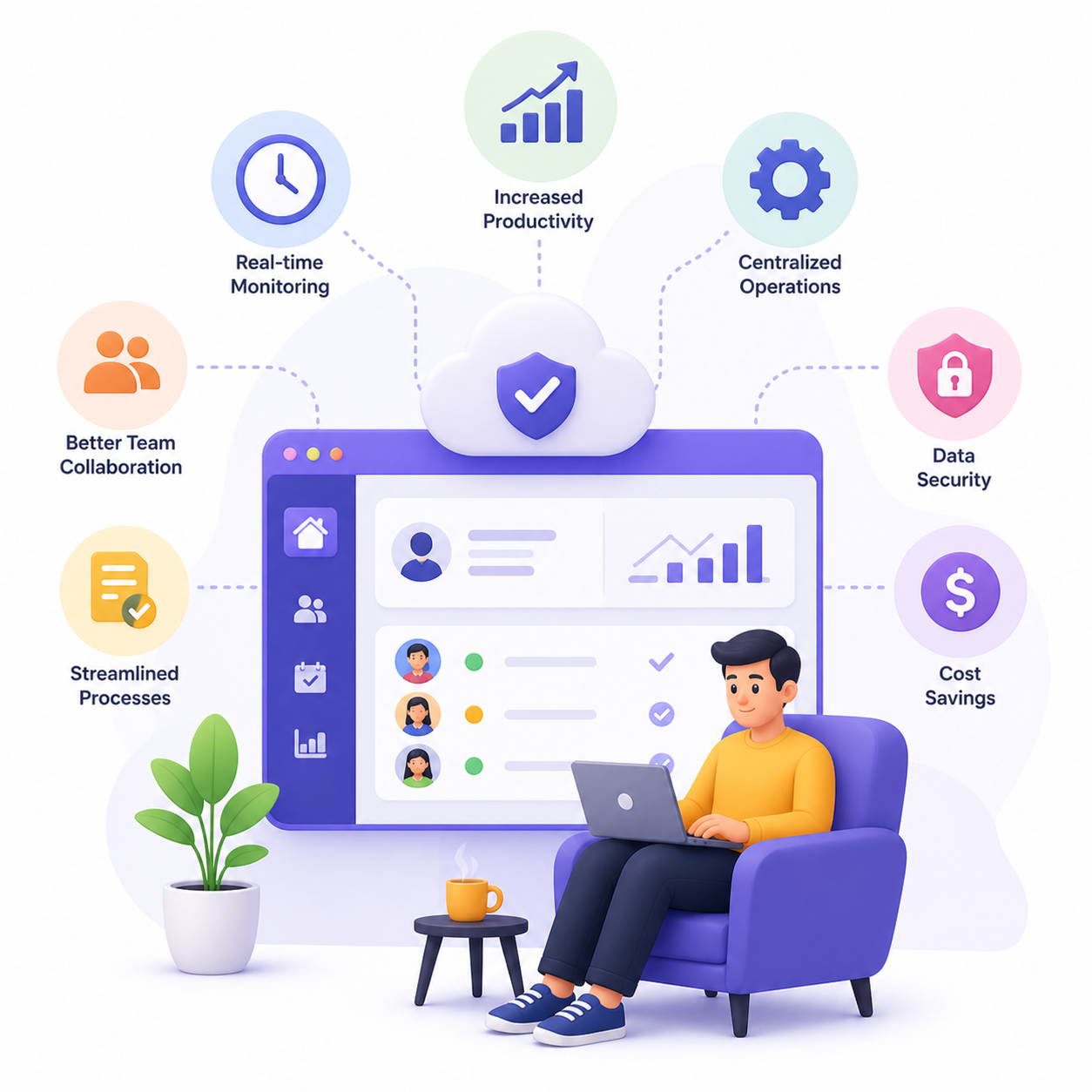
Deploying an HRMS software helps HR teams avoid all the challenges we discussed above. It automates various aspects of employee management, which helps HR teams create a structured system for managing them effectively. Through automation, HRMS solution empowers HR with improved productivity and increased efficiency, enabling streamlined processes.
Here are a few reasons why HRMS is essential for remote workforce management:
➔ Automated Payroll & Compliance
Since remote teams are located in various geographical locations, they would be governed by different payroll rules and regulations. A robust HRMS will be able to automatically calculate the exact payroll of each employee by considering the local and national labour laws. It also helps in keeping the payroll error-free while ensuring compliance.
➔ Simplified Employee Self-Service Portals
HRMS also provides the employees with dedicated Employee Self-Service (ESS) portals, empowering them to access and edit their HR-related tasks. It provides them with added visibility into their daily data, like attendance, payroll, leave, etc., improving organizational transparency. It will also reduce the administrative burden on HR teams, further improving their efficiency.
➔ Accurate Attendance & Time Tracking
A good HRMS also comes with robust attendance and time tracking options, resulting in error-free attendance records. It is especially useful for remote employees as attendance capture and time-tracking become automated, ensuring accurate results. It also helps pay employees’ salaries on time, since the system can also ensure that it remains tamper-proof.
➔ Enhanced Performance Management
Remote employee performance management is another critical task that an HRMS can simplify for HR teams. Using this system, HRs can set mutually agreed goals, track employee progress, and share reviews periodically. Similarly, it also enables a constant feedback system, which can be utilized even if the employees are working remotely.
➔ Easy Communication & Collaboration
By deploying an HRMS, you can also ensure easy communication and
collaboration between your team members. The software provides them with a platform
where they can communicate with each other and their team members, without having to
rely on any third-party apps. It improves team collaboration even for teams working
completely remotely.
Also Read: Role of HRMS Software in Talent Development
Deploying an HRMS is a complex process that requires investment in time, money, and
effort. It goes beyond simply digitizing the employee records, as you will be able to
transform your HR processes completely by implementing an HRMS software.
The following are some of the key advantages of remote workforce management with HRMS
software:

-in-india-complete-guide-2026.png)